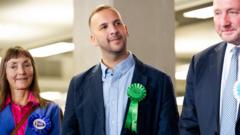
Green Party leader Zack Polanski has distanced himself from a controversial motion passed by his own members that labels Zionism a form of racism.
Speaking after a bruising week that included a second-place finish in a London by-election, Polanski admitted he would have voted against the final document. He called the motion “imperfect” and said he only would have supported it if party members had accepted key changes.
The vote took place at the Greens’ annual conference in Brighton. Polanski, who is Jewish, missed the debate because he was campaigning in the Holborn and St Pancras by-election, where he ultimately lost to Labour. He has spent the days since trying to navigate the fallout.
The Core of the Dispute
The approved motion describes Zionism as an ideology supporting “an ethnonationalist Jewish state” and calls for a single democratic state across all of historic Palestine. Polanski strongly objects to this latter point.
“The part I disagree with is the Green Party… or indeed even the British government deciding that there should be a single state,” Polanski told BBC Breakfast. “I think that’s up to the Israelis and the Palestinians.”
However, the party leader did defend other parts of the text. He argued that the “substantial part of the motion” — which asserts that Palestinian displacement is driven by a racist ideology — is “obvious.” Israel has consistently denied accusations of genocide or systematic racism.
Internal Backlash and Leadership Questions
Polanski had hoped to soften the motion’s impact. He proposed amendments to ensure Jewish party members would not face discipline for attending synagogues that identify as Zionist. Members rejected those changes, along with other watering-down attempts.
The decision to pass the motion sparked immediate backlash. Jewish community groups, including the Board of Deputies of British Jews, condemned the move as an outright attack on their community.
Pressure is also building within his own ranks. Former Green leader Caroline Lucas launched a scathing critique, calling the motion “dangerous, divisive, and flawed from top to bottom.” She publicly questioned Polanski’s leadership, telling BBC Newsnight that he had failed to show direction when it mattered most.
Polanski’s media appearances have done little to quiet the storm. Pressed repeatedly on BBC Radio 4’s Today programme on whether he believes Israel has a right to exist, he avoided a direct yes-or-no answer.
“I don’t believe any state has the right to oppress or to commit apartheid and certainly not genocide on another people,” he said.
Despite the double blow of the policy row and his electoral defeat, Polanski insists he has no plans to step down. “Yes, I’ve taken a loss tonight,” he said after the by-election results came in, “but our movement is so much bigger than one election or one motion.”