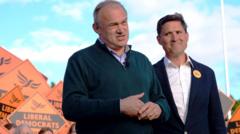
A fresh leadership rift has opened within the Liberal Democrats after frontbencher Charlie Maynard stepped down on Friday and called for Sir Ed Davey to be replaced.
Maynard, who represents the Oxfordshire seat of Witney, resigned his post as the party’s Treasury spokesperson. His departure marks the most overt challenge to Sir Ed since the general election, bringing simmering internal tensions over the party’s public profile and political strategy out into the open.
Allies of the party leader privately acknowledge that a handful of backbenchers have grown restive, but party figures moved swiftly to isolate the rebellion. Deputy leader Daisy Cooper offered a blunt defence of Sir Ed, stating that the overwhelming majority of Lib Dem parliamentarians back his leadership, want him to steer the party into the next campaign, and view the move as an infuriating distraction.
Simmering Tensions in Westminster
Former leader Tim Farron also dismissed the challenge with trademark sharpness. He argued that under Sir Ed, the party is well placed to repeat or even surpass its recent general election triumphs. To believe this kind of internal bickering is productive, Farron quipped, requires smoking substances that even the Liberal Democrats would never propose legalising.
A wave of frontbench colleagues echoed those sentiments on social media through Friday evening, eager to project unity. Yet Maynard’s exit is not an isolated departure. Just days earlier, Mid Sussex MP Alison Bennett stood down from her frontbench brief covering care and carers. Bennett gave no official explanation for leaving, though people familiar with the situation indicated the move was not driven by personal issues.
Maynard entered Parliament in the 2024 election after turning Witney—David Cameron’s former political stronghold—yellow with a majority exceeding 4,000 votes. Before his election, he spent years running an international firm specialising in mergers and acquisitions. His profile as a fiscally minded newcomer adds weight to his critique, even if his parliamentary allies remain quiet for now.

Questions Over Direction and Polling
Whether Maynard’s resignation gathers momentum remains uncertain. Julian Brazil, a Devon council leader who has voiced scepticism about Sir Ed in the past, said Maynard had boldly put his head above the parapet. Brazil noted that while Sir Ed had overseen substantial electoral gains, the party has struggled to capture public attention since, suggesting a fresh voice might be needed to communicate a coherent national alternative.
Sir Ed led the party to a historic return of 72 MPs in 2024, ending years in the political wilderness. Even so, the party has drifted in national opinion polls, rarely moving beyond its core baseline.
Friction over policy has also stoked frustration among backbenchers. Much of the recent irritation coalesced around Sir Ed’s staunch defence of the state pension triple lock. When Greater Manchester Mayor Andy Burnham proposed altering the mechanism, Sir Ed countered that doing so would hurt future retirees, arguing that today’s working millennials would face poorer pensions down the road.
That stance drew sharp internal pushback. Several MPs privately poured cold water on the argument, with one dismissing it outright as nonsense and noting that most younger workers doubt a universal state pension will exist by the time they reach old age.
The Hurdles to a Challenge
Despite the discontent, the arithmetic facing any potential challenger is formidable. Liberal Democrat rules require a majority of the parliamentary party to back a vote of no confidence before a formal contest can occur.
Even if that barrier were cleared, any contender would need official nominations from at least 10% of sitting MPs—excluding themselves—along with endorsements from 200 rank-and-file party members spread across at least 20 local branches. With 72 MPs now sitting on the green benches, the bar is considerably higher than it was during the party’s leaner years.
For now, Sir Ed’s inner circle remains confident they hold a commanding grip on the parliamentary group. But Maynard’s decision makes one thing plain: the discipline that carried the party to its biggest parliamentary haul in a century is beginning to show distinct cracks.