
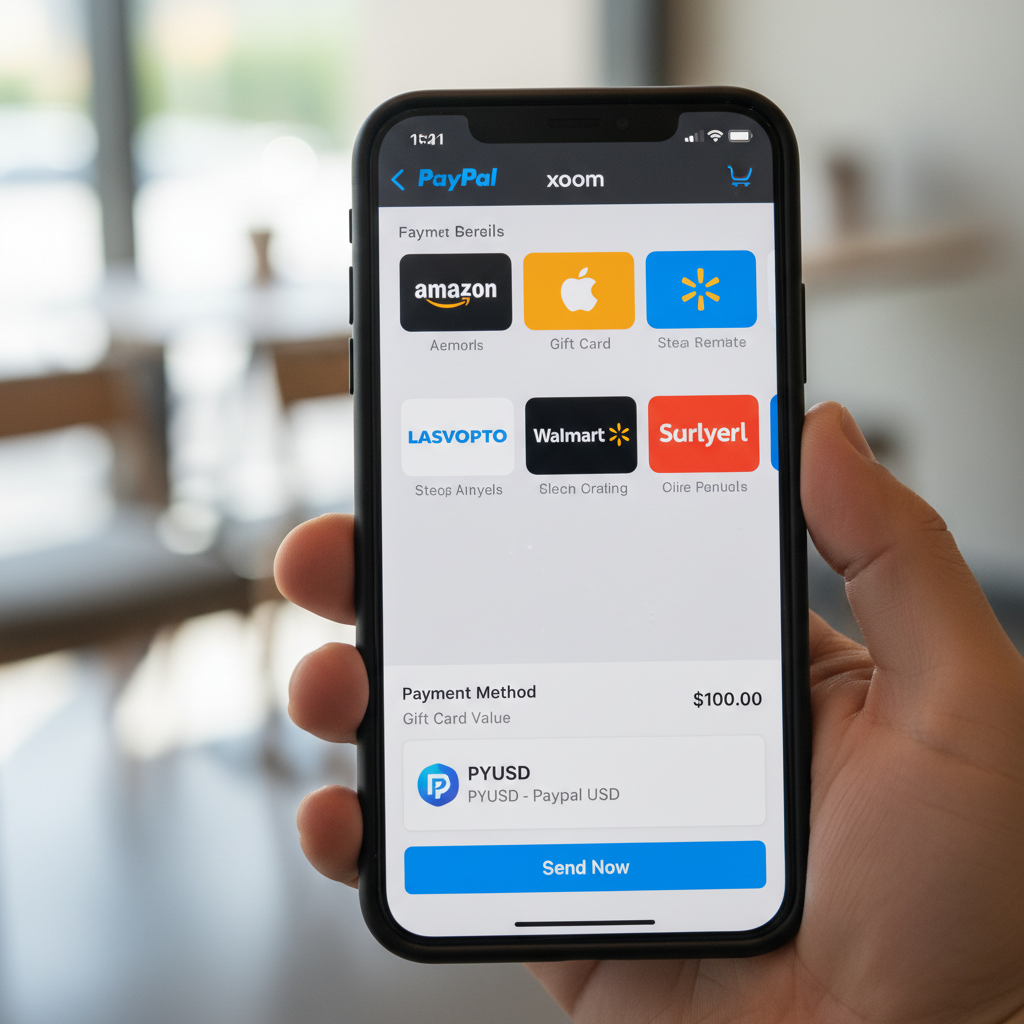
PayPal is making it cheaper to send gifts across borders. The payments giant just rolled out a new feature on its cross-border transfer platform, Xoom, allowing U.S. users to send international digital gift cards with zero transaction fees. The only requirement? Users must fund the purchase using PYUSD, PayPal’s proprietary stablecoin.
It is a tactical play. For years, critics have argued that cryptocurrencies lack practical, everyday utility. By tying its stablecoin to digital gift cards—a massive market for global diaspora communities—PayPal wants to prove that digital assets can solve real-world financial friction.
How the Zero-Fee Transfers Work
The process is straightforward. U.S. customers log into Xoom, pick a recipient in another country, and select a digital gift card from a list of local and international brands. At checkout, they choose PYUSD as their payment method. Xoom waives the transaction fee entirely, allowing the full value of the transfer to go directly to the recipient.
Normally, sending money or gift cards abroad involves a web of fees. Traditional remittance services charge flat transaction fees, percentage cuts, and currency markup rates. While PayPal’s new option eliminates the flat transaction fee, users should still watch out for currency conversion spreads if the gift card is issued in a foreign currency.
This is not PayPal’s first attempt to push its stablecoin into the remittance market. Earlier this spring, the company enabled fee-free international money transfers via Xoom for users funding payments with PYUSD. Expanding this to digital gift cards targets a slightly different, highly lucrative consumer segment.
Driving Adoption for PYUSD
PayPal launched PYUSD in August 2023, partnering with Paxos Trust Company to issue the token. The stablecoin is backed 1:1 by U.S. dollar deposits, short-term U.S. Treasuries, and similar cash equivalents. Despite PayPal’s massive global footprint of over 400 million active accounts, PYUSD faced a slow start.
To kickstart growth, PayPal expanded the stablecoin from Ethereum to the Solana blockchain. The move dramatically reduced transaction costs and increased speed, making PYUSD highly competitive against giants like Tether (USDT) and Circle’s USDC. This new Xoom integration serves as another bridge between mainstream retail consumers and the decentralized web.
The Battle for Remittances
Cross-border payments are a major battleground in fintech. Traditional banks and legacy wire services are slow and expensive. Newer digital-first platforms like Wise and Remitly have chipped away at their market share by offering lower fees and better exchange rates. Now, blockchain technology is threatening to disrupt the space even further.
By using its own stablecoin, PayPal can bypass many of the intermediate banks and clearinghouses that typically extract fees from international transfers. This efficiency allows them to offer the zero-fee incentive without eating into their own margins too deeply.
For everyday users, the tech behind the transaction is mostly invisible. They do not need to understand Solana or smart contracts to send a gift card to family in Mexico, India, or the Philippines. They just see a cheaper way to send a gift. And that is exactly how PayPal wants it.
About the Author