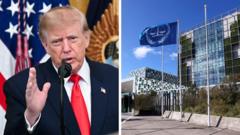
The Trump administration has escalated its confrontation with the International Criminal Court to historic heights, rolling out sweeping economic penalties against the tribunal itself in an effort to cripple its operations.
US Secretary of State Marco Rubio defended the move on Thursday, framing it as an essential shield for American sovereignty. Washington will bar American companies from providing the court with essential services, cutting off access to commercial banking rails, computer systems, and enterprise software. Unlike previous rounds that targeted 17 individual judges and prosecutors, this measure strikes at the entire organization.
Rubio put the administration’s goal bluntly: “Either the ICC will end its threats, or we will end the ICC.”
The Hague Condemns ‘Assault on Rule of Law’
In The Hague, the court’s leadership pushed back immediately. Court officials described the penalties as an assault on the international legal order designed to intimidate investigators and choke off justice for victims of atrocities.
“History will judge this moment,” the court said in a formal statement, insisting the tribunal “will not be deterred” by economic pressure.
The announcement created immediate diplomatic awkwardness. It came only hours after former ICC jurist Navi Pillay was named the recipient of the 2026 Nobel Peace Prize for her work defending international human rights.
United Nations Secretary-General Antonio Guterres called the US sanctions “a serious blow to our collective pursuit of international criminal justice, of which the ICC is a key pillar.”
Allies Push Back Against Washington
The move has opened a fresh fissure between the United States and its closest security partners. A coalition of key allies—including the United Kingdom, Canada, France, Germany, Italy, Japan, Denmark, and the Netherlands—issued a joint rebuttal, stating they “regret and strongly disagree” with the punitive measures.
The joint statement affirmed their steadfast backing for the tribunal’s mandate to hold perpetrators of genocide, war crimes, and crimes against humanity accountable.
The diplomatic bind is particularly acute for the Netherlands. As the host nation for the court, the Dutch government is caught between its obligations under the Rome Statute and its alliance with Washington. Dutch Foreign Minister Tom Berendsen warned that cutting the court off from corporate suppliers threatens to bring everyday administrative work to a standstill.
Six-Month Countdown
US officials built a temporary buffer into the executive order. A six-month grace period delays some of the harshest financial prohibitions, letting member states continue paying their operational dues while Washington pushes for concessions.
Rubio indicated the delay was intended to allow member governments to step in and “rein in” the court’s prosecutors, giving foreign capitals a narrow window to broker terms acceptable to the White House.
Root Causes of the Standoff
American hostility toward the court has simmered since its establishment in 2002. While 125 nations have ratified the court’s founding treaty, several global heavyweights never joined, including the United States, Russia, China, India, and Israel.
Tensions boiled over following earlier probes into actions by American soldiers during the war in Afghanistan—an inquiry prosecutors later shelved—and escalated dramatically after the court issued arrest warrants for senior Israeli officials, including Prime Minister Benjamin Netanyahu, over the conduct of the war in Gaza.
Netanyahu enthusiastically endorsed Washington’s offensive, calling the ICC a politicized body that poses a direct danger to law-abiding democracies and their sovereign rights.
With communications lines fraying and the six-month deadline ticking down, the tribunal is entering what observers consider the most perilous chapter of its 24-year existence.